Baseball has a God Problem
Giants pitchers wore Bible verses on Pride Night. The ensuing discourse evinces a complicated and layered relationship the sport has with Christianity and queer identity.

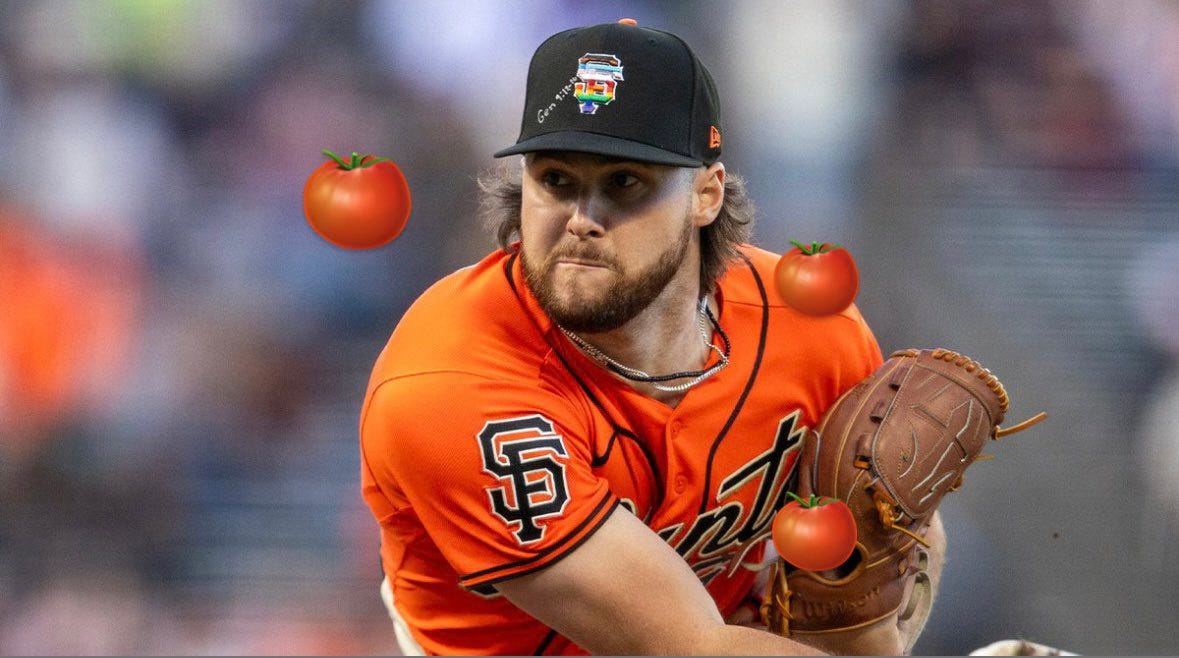
On Friday, June 12, San Francisco Giants pitcher Landen Roupp took the mound against the Chicago Cubs, wearing, like the rest of his teammates, a themed cap to coincide with the ballpark’s Pride Night. However, unlike most of his teammates, he chose to pair it with a bible verse, inked in silver Sharpie, inches away from the rainbow insignia.
The verse, worn not only by Roupp but also by relief pitchers JT Brubaker and Ryan Walker, is Genesis 9:12-16. In Roupp’s own words during his postgame interview, “it’s just about God’s covenant and the promise he makes to us.”
The verse itself does refer to God’s covenant, specifically with Noah after the flood, promising He will not flood the earth again. The creation of the rainbow is His everlasting reminder, both to Himself and to all living creatures, of that promise.
So what about this verse is significant enough for Roupp to write it on his cap? Why on Pride Night? Did he want the gay people in attendance that night to know that God will never flood the earth again? Or that a rainbow is, according to God, the symbol of his covenant and not a meteorological phenomenon or a symbol used for LGBTQIA+ identity?
Unfortunately, as is common in American Christianity today, the truth of the verse has been warped to promote an agenda Roupp has adopted as his own. Bible thumpers that disavow homosexuality and queerness, particularly its prevalence in modern American culture, use Genesis 9:12-16 as proof that the rainbow as a symbol for LGBTQIA+ identity is a misrepresentation of God’s will and testament. Silly gayboy, the rainbow isn’t for you! It’s for just us special Christians to remember God’s power and mercy! As if a symbol cannot have more than one meaning; as if the Christian cross doesn’t hold a myriad of meanings for every Christian that identifies with it.
But Roupp has explained his intention to either save us the guesswork or double it: “The rainbow is a symbol of God’s covenant to us, and us as believers stand firm in that... There’s no hate at all.” And if a fan catches a whiff of derision or discrimination in his decision? “As a believer, I would push them to read the Bible.”
I also wonder who Roupp refers to when he says “us”. Optimistically, I hope he only means his fellow pitchers that chose to wear the verse on their caps that night. More realistically, he likely refers to his idea of a Christian. If the reasoning is as benign and inconspicuous as Roupp would have us believe, it’s suspicious that he and his bullpen have forgone the verse for every other game of the season. I don’t anticipate it will make a return for their next themed game, unless Roupp takes umbrage with the faith of Hello Kitty fans as well as queer people.
It also doesn’t surprise me to hear him say that hate is not a factor in his decision. Religious extremist groups and conversion/detransition centers have similar messaging. In their minds, to evangelize the word of God to a nonbeliever—in other words, to tell a gay person their existence is a sin and blasphemes God—is the highest form of love one can offer. They provide a golden ticket to salvation for the most profane of humanity—according to them, if you accept God and his scripture, you will have a place in Heaven. But first, you have to cast off what goes against God’s word. According to their interpretation of the Bible, that includes homosexuality and gender fluidity.
This traumatizing attitude towards queer identity in some factions of the Church is what drives many queer people away from it, and it’s an insult to them and their experiences for Roupp and people like him to beseech them to return. And yet the most bigoted, self-described “Christians” love to do this more than anyone. They adopt their interpretation of God’s word, ascribe it to anyone who believes in God and Jesus, and by proxy imply that anyone who believes differently is not a true person of God.
Roupp and the Giants bullpen are far from the first to do this in their own sport; Dodgers pitcher Clayton Kershaw showcased the same verse in 2025, and this year Blake Treinen outright refused to wear the themed cap. In 2022, five Tampa Bay Rays players refused to wear Pride Night jerseys. The Rays are the closest MLB team to the site of the Pulse Massacre in Orlando, the largest instance of a mass shooting targeting the LGBTQIA+ community, which at the time of this Rays Pride Night was a week away from its 6th anniversary.
What is most disappointing about this most recent instance of protest is that it has happened in one of the country’s most historically LGBTQIA+-friendly cities, and on the team that began the trend of pride-themed uniforms back in 2021, when then-manager Gabe Kapler affirmed that acceptance and inclusion of their gay fans was important to the identity of the team and expressed pride in being the first team to do so. That stance, or really any pro-LGBTQIA+ stance from any MLB player in the league, is seen as wildly radical when compared to queer acceptance in mainstream culture. Braves pitcher Spencer Strider made waves this week for attending an org-sponsored Pride event, thanking fans for their support and affirming that their identity within the sport matters. Acceptance at its most basic form (though this shouldn’t be read as a dig at Strider, who was by no means required to show solidarity and likely knew it would come at a cost but did it anyway) was lauded by some MLB fans, decried by others, but drew reaction regardless. Meanwhile, support for the queer community from prominent celebrities is almost expected, politicians on both sides of the aisle send out Pride Month social media posts, and no one bats an eye. Even the Pope’s affirmation of gay identities was little more than a blip in the news cycle. So why is the MLB’s relationship to queer identity and acceptance so different?
Baseball is often described as either a game of failure or a game of luck. Out of any other major sport, there seems to be the weakest link between effort and results, though the link certainly still exists. In such an unpredictable and volatile sport, it’s understandable how some players would turn to an outside force like religion to find meaning, especially at a young and vulnerable age. Prospects are isolated from their family and friends in the naissance of their career, tossed around in the farm system and frequently uprooting their lives to chase their dream. Their commitment is expected; it’s a gift to have the opportunity, not a burden to be endured. Their only constant is the game of failure. Turning to religion to attempt to ground yourself amid the volatility of professional baseball seems a natural progression.
And to these prospects-turned-players, their faith has reaped rewards in spades. They’re happy to espouse the word of God because, in a testimonial way, it worked for them. (Roupp says it himself: “God has blessed me in so many ways, and I don’t think I’d be here right now if it wasn’t for him.”) Contracts and trades, promotion to the Majors, it’s all blessings from God. Their promised prosperity has manifested in a good swing, a nasty fastball, a diving catch in left field. They show gratitude for a home run they hit by pointing to the sky as they round the bases. Sure, they swung the bat, and watched the film of the pitcher before the game, and took hundreds of thousands, maybe millions, of practice swings in their life before that moment. But God had a hand in it, too.
I don’t dispute that there’s some truth to that. I consider myself a Christian and consider God’s scripture to be a significant influence in my life, especially on the topics of social justice, equality, and radical acceptance of all living creatures. But history is written by the victors. We don’t see the relationship with God that a failed ex-minor league pitcher-turned-high school baseball coach has. We don’t see how God is a factor in the life of a college freshman reliant on scholarship whose future in the sport is forever derided by an injury. Baseball, like life, produces winners, but it also produces many, many losers. Their stories aren’t written, they don’t make headlines, they don’t wear silver-Sharpied caps. It is easy to praise God in times of success, harder to trust in His wisdom in times of failure. We won’t see the hard parts, not from players like Roupp; I doubt that he would presently ascribe his above-MLB-average ERA to God’s plan. But with the press at his locker, he’ll take the opportunity to spread the word of his Lord and savior; when you’re paid in the millions to throw a baseball every five days, why wouldn’t you praise God?
“It’s just something I believe in and I stand firm in that,” he said, espousing his faith in postgame interviews. “Thankfully we live in a country where we have the freedom to believe what we want.” Roupp is extremely fortunate, not just because he has the skill (or God’s gift, whichever you prefer) of an MLB pitcher. He’s a white man in a white man’s world. He’s never had his freedom of expression or identity countered, not once. I don’t know him personally, I’d never heard of him before yesterday’s game, but I can say that for nearly a fact. Men like him move through the world differently because they don’t experience oppression the way marginalized people do. He probably thinks his brand of Christianity is being oppressed by the Woke Left or something, but his philosophy, thank God, is not reality.
But his privilege, and by proxy his naivete, is evidenced by his words, and tacitly supported by the flagrant patriotism in the MLB: he truly believes the United States is a country of freedom. While he expresses his gratitude for the First Amendment, his fellow Americans are at harm simply for identifying with the group he so fervently disavows. A leading cause of death for transgender Americans is either homicide or suicide. Book banning is at an all time high across the country, with most titles targeted because of themes of homosexuality and queerness. Children in rural or conservatively governed regions of the country have no connection with or method to explore their gender or sexual identity. The week before Roupp took the mound, the Cleveland Clinic, consistently ranked as one of the best hospitals in the world, agreed to end gender-affirming care for youth and instead invest those resources into conversion therapies. They are just one of many medical organizations in the country that has capitulated to the Department of Justice, an effective weapon wielded by a virulent and corrupt presidential administration that would likely dismantle the First Amendment if they could (and very well might). I don’t know who Landen Roupp voted for, but his brand of Christianity has long aligned itself with Donald Trump, the man perpetuating a social, economic, cultural, and political divide in our country so chasmic as to appear beyond hope of repair.
Roupp and the Giants bullpen believe fiercely in their God-given, Constitutionally-protected right to express their beliefs, no matter how hateful or narrow-minded. To them, their freedom to tell a group of people—of devoted fans—that they are not welcome as they are comes at no cost. To the fans they excoriate, the statement is everything. It shuts the door on what should be a safe space for a marginalized group seeking escape from the harsh reality of life as a gay or trans person in America.
The Giants are guaranteed 162 games; if his God-given ERA doesn’t skyrocket, Roupp will likely have his name on about a fifth of them. The LGBTQIA+ community in San Francisco had only one, and that was one too many for Roupp, his cohort, and his version of God. May they find forgiveness from the Lord for their sin, for Romans 15:7 so decrees: “Accept one another, then, just as Christ accepted you, in order to bring praise to God.”
(My quotes of Roupp came from his interview with KNBR.)
Edit: I had no good place to mention Glenn Burke and Billy Bean in this article, but I would be remiss to not at least shout them out in the footnotes and acknowledge the positive change they enacted in the sport. Maybe a topic for next time…
Love that you wrote about this! I definitely understand how finding faith can help prospects with the struggle of pro-baseball and how much failure they endure. I also like that you mention that Roupp is far from the first player to do this.